
Quick Summary
Automated driveway gate failures like humming motors, power loss, or stalling often stem from isolated electrical faults or physical track binding rather than total motor burnout. As Southlake's gate automation specialist, Ironworks Gate Co. delivers fast diagnostics and targeted electric gate motor repair for issues like failed capacitors, worn drive gears, and misaligned limit switches without pushing unnecessary full-system replacements. Readers will understand how to evaluate common operator symptoms, compare repair costs, and call Ironworks Gate Co. to schedule a free on-site gate motor assessment with an upfront, written estimate.
Electric Gate Motor Repair: Fast Diagnostics and Direct Fixes
When an automated driveway gate stops opening, hums under load, or loses power completely, it does not necessarily mean the entire operator is ruined. Many breakdowns can be traced to specific components such as worn capacitors, misaligned limit switches, blown fuses, damaged wiring, or physical gate drag. Rather than replacing the entire system, isolating and replacing the malfunctioning component can often restore gate operation efficiently.
Proper gate motor troubleshooting requires specialized diagnostic equipment and compatible replacement components. Diagnostic testing helps identify whether the failure originates in the electrical supply, control circuitry, drive mechanisms, or external safety devices before determining whether a component repair or complete operator replacement is necessary.
Fast Diagnostic Protocol for Swing and Slide Gate Operators
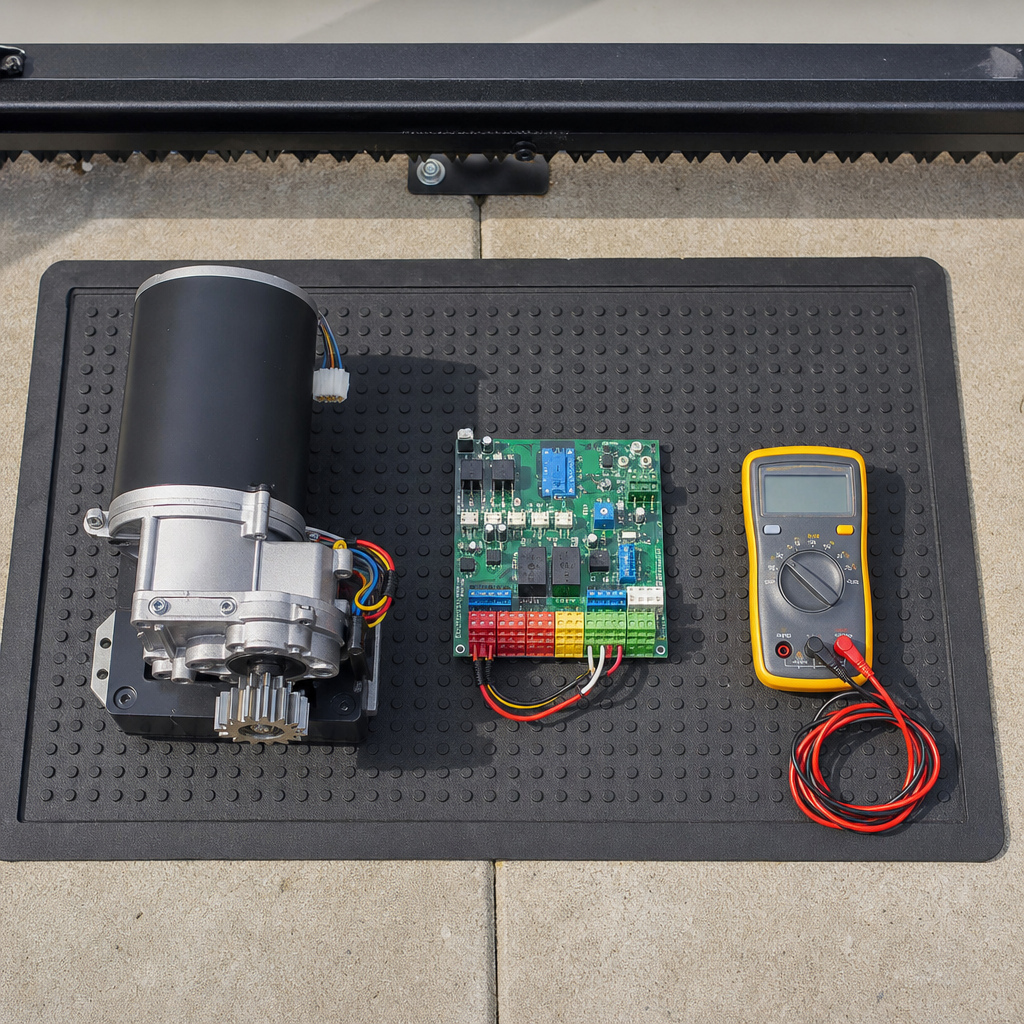
According to specialists at Ironworks Gate Co., accurate electric gate motor repair starts by separating electrical faults from mechanical resistance. When a motor struggles, inspecting incoming power feeds, capacitors, control circuit boards, drive gears, couplings, belts, limit switches, and safety sensors ensures an accurate diagnosis.
What to Expect During a Professional Diagnostic Visit
Mechanical binding is frequently misdiagnosed as an internal drive failure. When hinges bind, tracks shift, or hardware misaligns, the operator draws higher amperage, which can trip an internal overload switch or blow a fuse.
A standard diagnostic workflow includes:
- Initial Power and Safety Check: Testing line voltage, fuses, breakers, and active safety sensor inputs.
- Mechanical and Load Inspection: Disengaging the drive mechanism to verify manual gate movement and check for binding or physical resistance.
- Component-Level Testing: Inspecting the motor, start and run capacitors, control board relays, limit switches, drive gears, couplings, and belts.
Mechanical Resistance and Operator Load
As technicians at Ironworks Gate Co. point out, gate operators can experience premature wear or electrical shutoffs when forced to move misaligned or jammed gates. Over time, structural settling, worn hinges, or warped tracks create physical drag, causing the motor to operate under excessive load until internal protection mechanisms engage.
Mechanical Drag vs. Electrical Motor Failure
A gate that stalls or hums may be reacting to physical binding rather than total motor burnout. Steps to evaluate physical resistance include:
- Disconnecting the operator arm, chain, or belt to test manual gate travel by hand.
- Checking hinges, rollers, guide tracks, and mounting brackets for friction, wear, or misalignment.
- Inspecting internal drive gears, belts, and couplings for stripping, excessive play, or physical jamming.
Troubleshooting Common Failure Modes
Need electric gate motor repair?
We’re available now - call for a fast, free estimate.
Power Loss, Blown Fuses, and Wiring Faults
If an operator shows no signs of life, the primary causes include an interrupted power supply, tripped breakers, blown control board fuses, damaged low-voltage wiring, or degraded wire connections. Checking continuity and voltage across the primary and secondary circuits identifies where power is lost.
Humming Motors and Starting Issues
A humming gate motor indicates that electrical power is reaching the unit, but the rotor is unable to turn. As noted by Ironworks Gate Co., this symptom can stem from several distinct issues, including a failed capacitor, a jammed drive gear, a broken coupling, worn motor windings, or severe mechanical binding along the gate track or hinge.
Limit Switches, Drive Gears, Couplings, and Belts
When an operator stops at incorrect positions, reverses unexpectedly, or runs without moving the gate, the mechanical drive components and positioning sensors should be checked:
- Limit Switches: Verify that limit switches and cams trigger accurately at open and closed positions without sticking.
- Drive Gears and Couplings: Check for stripped internal gears, sheared drive pins, or damaged couplings between the motor and gearbox.
- Drive Chains and Belts: Inspect drive belts and chains for correct tension, wear, fraying, or slipping on the drive sprockets and pulleys.
Safety Sensors and Photo-Eyes
Automated gates rely on monitored safety devices such as photo-eyes and edge sensors to prevent closure on obstructions. Dirty optical lenses, misaligned sensor heads, or severed signal wiring can trigger a continuous safety hold, preventing the gate from operating.
Electric Gate Motor Repair Costs and Options
Industry estimates from Ironworks Gate Co. show that repair costs vary depending on the specific component that has failed, the gate type, and the age of the operator. Diagnostic service fees generally range from $75 to $150. Capacitor replacements and minor wiring fixes typically cost between $100 and $250. Replacing control boards, limit assemblies, or drive gears generally ranges from $250 to $600. When a complete motor or operator replacement is required, total costs typically range from $500 to $2,500 or more, depending on system specifications.[1]
| Service Scope | Diagnostic and Minor Electrical Fix | Component Repair (Board, Gears, Capacitor) | Motor or Full Operator Replacement |
|---|---|---|---|
| Typical Cost Range | $75 – $250 | $200 – $600 | $500 – $2,500+ |
| Primary Focus | Fuses, wiring, capacitors, sensor alignment | Control boards, drive gears, limit switches, belts | Replacement motor unit or complete operator chassis |
| Best Application | Power issues, sensor blocks, minor electrical faults | Specific mechanical wear or board-level failures | Burned motor windings, severe mechanical damage, or obsolete units |
Frequently Asked Questions
Why is my electric gate motor humming but not opening?
A humming motor indicates that power is reaching the unit, but rotation is blocked. Plausible causes include a failed start or run capacitor, a seized drive gear, a damaged coupling, worn motor bearings, or physical obstruction along the gate hinges and track.
Can an electric gate motor be repaired, or does it need to be replaced?
According to Ironworks Gate Co., many gate operators can be repaired by replacing individual worn or damaged components, such as capacitors, limit switches, control boards, belts, or drive gears. Replacement is generally reserved for severe motor winding burnout, extensive mechanical housing damage, or outdated systems where parts are unavailable.[2]
What causes an electric gate opener to stop working suddenly?
Sudden failures are commonly caused by power interruptions, blown fuses, failed safety photo-eyes, damaged wiring, or a disengaged drive coupling.
How do I manually open an electric gate if the motor fails?
Most automated operators include a manual release mechanism. Slide gate operators typically feature a keyed release or disconnect lever on the drive chain sprocket. Swing gate operators usually feature a manual release key, pin, or bolt on the drive arm that allows the gate to swing freely by hand.
Need electric gate motor repair?
We’re available now - call for a fast, free estimate.
Sources
- Publication – ars.usda.gov (2012)
- NICE / APOLLO Gate Opener Replacement Parts – gateopenersunlimited.com
Related reading: Automatic Gate Repair – Call Now-10% Off – On-Site in 60 Minutes – Free Estimate
Related reading: Swing Gate Repair – 10% Off & Free Estimate – On-Site in 60 Minutes
Frequently Asked Questions
Can electric gate motor repair typically be completed on the same day?
Yes, common component failures such as blown capacitors, misaligned limit switches, or stripped gears can often be repaired in a single service visit. Ironworks Gate Co. delivers same-day electric gate motor repairs in Southlake, carrying diagnostic equipment and replacement parts to restore operation quickly without pushing full-system replacements.
How do I know if my gate motor needs an individual part repair or a full replacement?
If the issue stems from a faulty capacitor, relay board, or mechanical track drag, targeted component repairs are significantly more cost-effective than a total overhaul. Full operator replacement is generally only required for catastrophic motor winding burnout or obsolete systems, and Ironworks Gate Co. provides upfront, written estimates during a free on-site assessment to guide your decision.
What happens during a professional electric gate motor diagnostic assessment?
Technicians disengage the operator to manually test hinges and tracks for mechanical resistance before running continuity and load tests across the power feed, capacitors, circuit boards, and safety photo-eyes. You can call Ironworks Gate Co. to schedule a free on-site gate motor assessment and receive an accurate, written repair estimate before any work begins.
About the author
 |
Sarah Jenkins Sarah Jenkins is an access control specialist with over eight years of experience managing residential and commercial gate systems in North Texas. She holds a B.S. in Electrical Engineering from the University of Texas at Arlington and focuses on providing homeowners and facility managers with clear, practical guidance on troubleshooting, maintenance, and perimeter security. Her writing emphasizes transparent pricing and reliable solutions for automatic gate repair. |
Gate not opening, off track, or opener dead?
We’re available now - call for a fast, free estimate.
Call Now - Free Estimate