
Emergency Gate Repair Near Me: What Southlake Homeowners Should Do First
If your gate just failed, stop before you touch anything. The first ten minutes decide whether you’re looking at a simple fix or a half-day repair with a bigger bill. Yanking the emergency release cord on a gate opener that has failed mid-cycle does not free the gate. On most swing and slide operators, it locks the drive arm in place and turns a one-hour service call into a job that requires rebuilding the operator. Take a breath, follow the steps below, and you’ll protect both your gate and your wallet. If you’d rather not deal with it at all, call us at (817) 580-8494 and a live person will walk you through it.
First: A Five-Minute Safety Check That Won’t Make Things Worse
Before you pull any cord or press any button, run through this quick assessment. It takes less than five minutes and tells you whether you’re dealing with an electrical issue, a mechanical failure, or an operator fault. Knowing this matters because it determines what you do next and what you tell the technician when they arrive.
- Look at the gate’s position. Is it fully open, fully closed, or stuck halfway? A gate stuck halfway on a slide track often means a broken limit switch or a physical obstruction. A swing gate stuck partway usually points to a hinge problem or the operator’s drive arm binding.
- Listen for the motor. Press the remote or keypad once. Do you hear a hum? A hum with no movement typically means a capacitor failure or stripped gear, especially on older LiftMaster and FAAC models. Complete silence suggests a power issue or a fried control board.
- Check the breaker. Gate openers in Southlake homes are usually on a dedicated circuit, often labeled “gate” or “garage” in the main panel. If it tripped, reset it once and try again. If it trips immediately, do not reset it again. That’s a short, and repeated resets can damage the motor windings.
- Look at the ground around the gate. Recent rain softens the soil in Southlake, which shifts gate posts slightly. Even an eighth of an inch is enough to throw a swing gate out of alignment so the latch won’t release and the operator strains against the frame.
We’ve pulled a Mighty Mule opener out of a gate over in Monticello last month where the homeowner had pressed the remote seventeen times. Each press overheated the circuit board a little more. What started as a broken safety beam became a board replacement because the opener kept trying to run against a gate that couldn’t move. One press, one observation. Then call.
How to Manually Disengage Your Gate Opener Without Damaging It
Every gate opener has a manual release, but the way you use it depends on the type of operator. Pulling the wrong thing, or pulling in the wrong order, can strip the gears or bind the drive mechanism. Here’s what to do for the three most common setups in Southlake driveways.
Swing Arm Operators
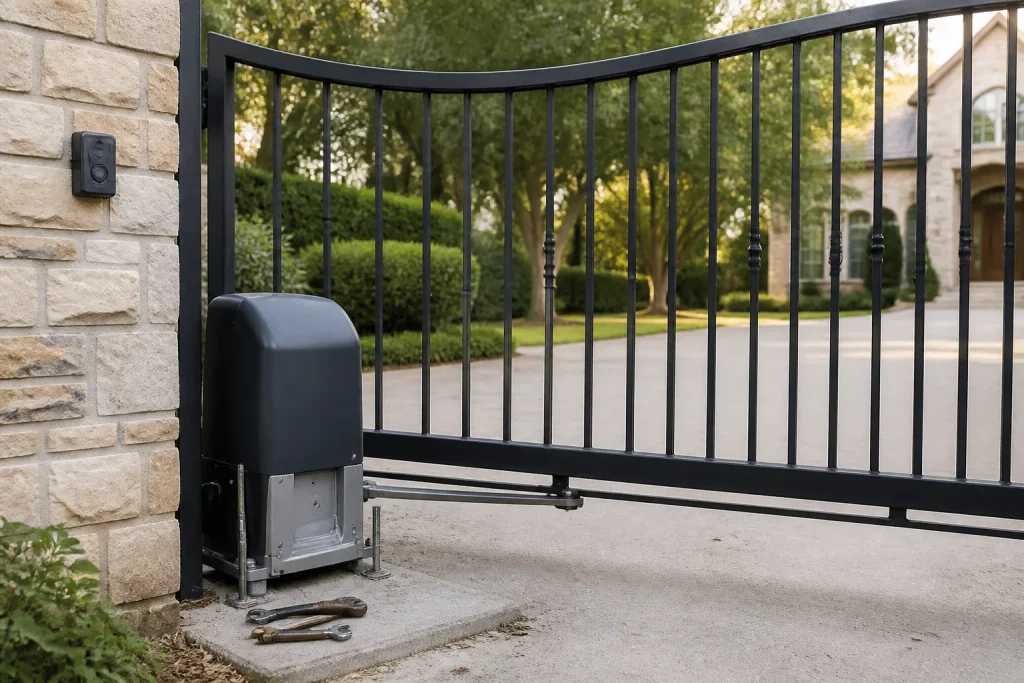
These are the most common on residential estate gates. There’s usually a small lever or pull-ring at the base of the arm where it meets the gate. The correct sequence is to pull that release gently, then manually move the gate with your hands while supporting the arm. Do not let the arm drop or swing free. A dropped swing arm bends the piston rod, and that’s a part most supply shops in the DFW area don’t stock same-day.
Slide Gate Operators
Slide operators sit beside the gate, not on it. The release mechanism is typically a keyed lever on the side of the motor housing. Unlock it and the gate will roll freely on its track. But before you push it, crouch down and check the track for debris. Southlake wind pushes leaves and gravel into slide tracks constantly, and forcing the gate over a pebble can pop the wheels off the rail. Clear the track first.
Overhead or Jackshaft Operators
Less common in residential Southlake but present on some custom estates. These have a pull chain or manual crank. If you’re not sure where the release is on this type, don’t guess. A wrong guess on a jackshaft operator can drop tension in the chain and create a safety hazard.
The point here isn’t to turn you into a gate technician. It’s to get your gate open or closed manually so you can use your driveway again until someone who does this every day arrives. And a note: if the gate is heavy, and most solid iron gates in Southlake are, get a second person to help you move it. A 400-pound gate swinging uncontrolled can hurt you faster than you think it can.
How to Temporarily Secure an Open Gate in Southlake
An open gate overnight is a liability. It exposes your property, and depending on where you live in Southlake, it may put you out of compliance with HOA requirements about fencing and perimeter security. Most Southlake HOAs require gates to be functional and closed when not in active use, and repair timelines matter.
Here’s a workable temporary fix that satisfies basic safety and HOA expectations until a proper repair is made:
- Close the gate manually using the correct disengagement method above. Move it slowly.
- Use a heavy-duty ratchet strap to bind the gate to its post or to a fixed structural point. Wrap it twice and cinch it down. Don’t use rope; rope stretches and a stretched rope drops a gate on a car bumper.
- If the gate can’t close because of the failure, use temporary fencing panels or plastic construction barricade mesh across the opening. Bolt or zip-tie it to the gate and the opposing post.
- Tag the opener so nobody presses the remote and triggers a partial cycle against a bound gate. A strip of blue painter’s tape across the keypad with “OUT OF SERVICE” written in marker works.
This isn’t a permanent solution and shouldn’t be treated as one. A strapped gate puts zero load on the opener, which is fine for a day or two, but the longer the gate sits secured this way, the more likely the posts shift or the strap wears. We recommend scheduling a repair within 48 hours whenever possible. Our team at Gate Repair in Southlake handles these calls every week, and the most common next-day problems we see are gates that were left strapped for a week and the tracks got fouled by wind-blown debris.
What to Have Ready Before You Call a Gate Repair Company
The difference between a one-visit fix and a two-visit job often comes down to what you tell the dispatcher. When you’re standing in front of a dead gate, frustrated and late for something, it’s easy to forget details. Here’s what we ask for on every emergency call, and it’s the same list any competent gate company in Southlake should want.
- The operator brand and model. Look for a label on the motor housing or control box. LiftMaster, FAAC, BFT, Mighty Mule. If you can’t find the brand, describe the color and shape of the unit. Our technicians carry parts for nine major brands including LiftMaster, FAAC, BFT, and Mighty Mule, so we can usually make the correct fix on the first visit.
- What the gate was doing when it failed. Half-open? Closed and wouldn’t respond? Opened then immediately reversed? These details point to different faults.
- Any error codes. Many openers show a blinking light sequence or a digital code on the board. Photograph it with your phone. Don’t try to interpret it yourself, just capture it.
- A photo of the whole gate setup. Stand back 20 feet and shoot one wide photo that shows the gate, the operator, and the posts. Then one close-up of the operator. This helps the technician arrive with the right parts and the right mindset.
- Property access notes. Gate codes, lockbox locations, dogs, driveway obstacles. Tell the dispatcher everything now so the technician isn’t standing at the street calling you later.
We can’t speak for every company, but when someone calls Ironworks with this information ready, the average repair moves noticeably faster. And the price is quoted and agreed before any work starts, so you know what you’re paying before a single bolt is turned.
Is This a True Emergency or Can It Wait Until Morning?
In the middle of a Southlake night with a dead gate and a car stuck behind it, everything feels urgent. But most gate failures are not true emergencies, and knowing the difference saves you after-hours dispatch fees and gets you scheduled for a daylight repair when parts are more accessible.
True emergencies: The gate is stuck open and your property is unsecured. The gate is stuck closed and blocks the only vehicle access to your home. The opener is making grinding or smoking sounds. A child or pet can access the street through the opening. The gate fell off its track or came loose from a hinge and is a physical hazard.
Can wait until morning: The gate moves slowly but still opens and closes. The keypad works intermittently. The opener makes an unusual sound but still cycles. The gate sits slightly crooked but operates. The safety beam is out but the gate still functions manually. The remote only works from short range.
Here’s the honest guidance: if the gate still opens and closes, even slowly, you can wait. If it doesn’t, call. We answer the phone 24 hours a day, 7 days a week, and a live person will help you decide what’s urgent and what can be scheduled. No voicemail trees, no callback queues. Southlake homeowners should never have to guess whether their situation is an emergency or not.
What Actually Breaks Most Often on Gates in Southlake
In our experience across Southlake, Timber Lake, Clariden Ranch, and the estates off Dove Road, the same handful of failures repeat themselves. Knowing these helps homeowners understand what the technician is looking for and why the repair costs what it does.
- Capacitors on swing and slide openers. The most common single component failure we see. A capacitor that fails prevents the motor from starting under load. It’s usually a quick fix, often on the first visit, sometimes with the part already on the truck.
- Broken safety beams or misaligned photo eyes. The little sensors near the ground on either side of the gate opening get bumped by mowers, washed out by rain, or sun-faded over time. When they fail, the gate won’t close or reverses immediately.
- Hinge wear on heavy iron gates. Southlake’s clay soil shifts with seasonal moisture changes, and over decades a heavy iron gate carries that stress into its hinges. Worn hinges bind, which overloads the opener, which fails. A hinge replacement done early saves an opener replacement later.
- Circuit board failures on older operators. Texas heat does no favors to electronics mounted in metal boxes facing the afternoon sun. Older LiftMaster and FAAC boards cook slowly over years, and one day they just won’t respond.
We’ve also seen a fair number of BFT hydraulic operators with fluid leaks, most of them on gates installed in the 2000s. And Mighty Mule operators that were never installed with surge protection, which matters in North Texas where lightning and grid fluctuations are routine.
If any of this sounds familiar, we’d rather hear about it while the gate is still working than after it stops completely. A $89 seasonal tune-up catches these things before they strand you. Our full scope includes gate repair, gate installation, gate motors and openers, access control, and welding, and every job is covered by our 90-Day Done Right Promise, in writing.
When to Call a Pro Instead of Troubleshooting Further
You can run the safety check, try a careful manual release, and secure the gate temporarily. But there are moments when continued do-it-yourself effort becomes a risk. If any of these apply, call (817) 580-8494 now.
- The opener smoked, sparked, or has a burning smell. That’s an electrical fault. Shut the breaker off and leave it off until a technician arrives.
- The gate came off its track or the hinge welds cracked. A detached gate is a stored-energy hazard. Don’t stand down-slope of it.
- You pulled the emergency release and the gate still won’t budge. That typically means a mechanical bind in the hinge or the post, and forcing it further risks bending the frame.
- There are exposed wires, chewed insulation, or a flood-damaged control board. Water and electricity inside a metal enclosure is exactly what professional gear is for.
None of this is admission of defeat. It’s the same judgment you’d apply to a breaker panel that keeps tripping or a water heater hissing from the top. Some things a homeowner fixes. Some things a professional fixes. The trick is knowing which is which before the repair bill doubles.
For related work beyond this emergency scenario, see our Gate Installation in Southlake page if the gate is beyond repair, or Gate Motor & Opener in Southlake if the operator itself is gone. And the Ironworks Gate Co. home page covers the full range of what we do.
The Bottom Line
When a gate fails in Southlake, the first thing to do is observe before you operate. Check the breaker once. Listen once. Look at the ground and the track. Then decide whether you can safely move the gate manually or whether it needs to stay put until a technician arrives. Secure an open gate with a ratchet strap or temporary fencing panel. Gather the photos, brand name, and access details before you call. And know that a slow gate can usually wait until morning, while a stuck-open gate in a neighborhood with an active HOA cannot.
If you’re in Southlake and your gate won’t cooperate, call Ironworks Gate Co. at (817) 580-8494 for a free estimate. We answer live, 24 hours a day, and we’ll tell you honestly whether it’s a tonight problem or a tomorrow problem. The price is quoted and agreed before any work starts. Done right, and backed in writing.
Frequently Asked Questions
Emergency gate repair in Southlake typically runs between $180 and $450 depending on the fault. A capacitor replacement or safety beam fix often lands at the lower end. A board replacement or a hinge rebuild runs higher, and after-hours dispatch may add a fee. Every Ironworks Gate Co. job is quoted and agreed before work starts, so the number on the invoice is the number you approved. Call (817) 580-8494 for an exact quote, estimates are free.
Yes. For true emergencies, we dispatch same-day and a live person answers the phone around the clock. If your gate is stuck open or blocking your only vehicle access, call (817) 580-8494 and tell the dispatcher exactly what’s happening. The more detail you provide from the list above, the faster the technician can get on the road and the more likely they arrive with the right parts.
It can if you pull it at the wrong time or on the wrong operator. On swing arms, pulling the release while the motor is mid-cycle can bind the drive arm. On slide gates, pulling the release and then forcing the gate over debris can pop the wheels off the track. If you’re unsure which type of release you have, call us before you pull anything and we’ll walk you through it by phone.
Usually yes, but not an emergency. A gate that moves noticeably slower than it used to typically means a failing capacitor, low fluid on a hydraulic operator, or a mechanical bind in the hinges. Left alone, the strain transfers to the motor and the repair grows. It can usually wait until a scheduled visit rather than an after-hours dispatch. Call (817) 580-8494 and we’ll help you decide which it is.
Written by Victor Salinas, Owner at Ironworks Gate Co., serving Southlake since 2013.
Need Gate Repair Help?
Call Ironworks Gate Co. - licensed & insured, here with fast after-hours help in Southlake.
(817) 580-8494